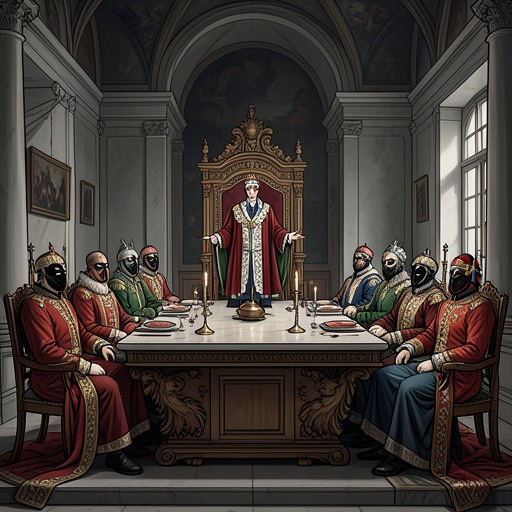
Anne Boleyn’s public defiance of Katherine at the masque
The King's CurseAnne Boleyn’s public defiance of Katherine at the masque turns a court entertainment into a visible challenge to the queen’s precedence. When Katherine withdraws, Anne does not follow her in the ordered train of ladies. The king permits her to remain, and the court witnesses a breach that Margaret Pole first mistakes for an error before recognizing as a deliberate change in the room’s hierarchy.
The Masque and Its Ceremony
The episode unfolds at a formal masque in which Princess Mary Tudor and seven ladies emerge from painted scenery to dance with eight costumed knights. The princess, elaborately dressed and trained for the occasion, initially commands the company’s attention. After the masque, the French ambassador asks her to dance, and she takes her place at the head of the set. Across the room, Henry VIII dances with Anne Boleyn while Katherine of Aragon watches. The arrangement places the royal family and its guests in a public performance where rank is expressed through who dances, who watches, and who is accorded the leading place.
The dancing continues late into the night. Only after midnight does Katherine rise from beneath the cloth of estate and curtsey to Henry VIII. He responds with visible respect, takes her hand, and kisses her on both cheeks. The formal exchange appears to preserve the queen’s standing. Her ladies and companions then prepare to leave with her: Princess Mary Tudor comes behind her mother, followed by Mary Tudor Brandon, the Dowager Queen of France, and the other women in order of precedence. Anne, however, does not move with them.
Anne Refuses to Follow
Margaret initially reads Anne’s stillness as an awkward mistake. She thinks Anne has failed to notice that the queen and her train are leaving, and steps forward intending to take her by the arm and discreetly guide her into line. Then Margaret notices the tilt of Anne’s head and the challenge in her smile, and hesitates. What had looked like inattention now appears to be a choice.
Anne remains among a circle of the court’s handsome men, wearing a crimson French hood set with rubies and gold thread and a red velvet gown. She makes a shallow curtsey but does not hurry to join Katherine’s train. Her position is consequential because the established custom required her to withdraw behind the queen and the many ladies who, by birth and rank, stood ahead of her. Anne was the daughter of a simple knight; the order of precedence made her place in the departing company unmistakable. By staying, she declines to enact that subordination before the assembled court.
The moment produces a pause. Katherine looks from her husband to Anne, seeming to recognize that something new is taking place. Anne does not withdraw, Katherine does not order her to do so, and Henry VIII allows the situation to stand. The scene’s force rests less on an exchange of words than on this uncorrected breach of ritual: the king’s permission and the queen’s silence leave Anne’s position publicly altered.
Katherine’s Withdrawal and Margaret’s Response
Katherine gives a small shrug and leaves the hall with her head held high. The others follow in the established order: Princess Mary Tudor, the king’s sister, royal cousins including Margaret, and the remaining ladies. Their collective departure preserves Katherine’s train even as Anne’s refusal has disrupted its authority. The company walks away in silence; from the stairs, they hear Anne’s giggle. The contrast between the formal procession and the sound left behind sharpens the sense that the old arrangement has been challenged in full view of the court.
Margaret’s first response after the masque is to summon Montague and Arthur to her rooms at dawn, before breakfast, Prime, or the household’s usual activity. She tells them sharply that they should have informed her matters had gone so far. This reaction shows that she regards Anne’s conduct not as an isolated breach of manners but as evidence of a development she needed to understand. The episode does not establish that the masque itself changes the political situation; it makes a change already under way visible to those present.
Precedence, Marriage, and Public Power
The scene gains additional weight from the dispute over Katherine’s marriage. In an earlier confrontation, Katherine demands that Margaret confirm that Prince Arthur and the dowager princess were put together in her household each week. Margaret acknowledges that she obeyed the order, but does not claim to know whether the marriage was consummated. Katherine fears that the allegation that it was not consummated could enable Henry VIII to obtain a papal dispensation to marry his former daughter-in-law. She accuses Margaret of supporting that claim and demands that she affirm the marriage was consummated. The masque’s public arrangement thus takes place within a wider conflict over Katherine’s marital status and the security of her position.
Later scenes also show court ceremony carrying political meaning beyond its immediate protocol. At Westminster Palace, Thomas Cromwell administers the oath of succession to the assembled nobility while Margaret recalls that the Pope has ruled Katherine and Henry’s marriage valid. Henry VIII’s claim that his own declaration can determine the marriage and succession reveals how contested authority has become. In this setting, the masque’s order of departure is not simply decorative etiquette: who follows the queen, and who remains with the king, can make a disputed hierarchy visible.
The later public reception of Princess Mary Tudor offers a contrasting image of ritual and rank. During the royal progress across the frozen river in London, the crowd gives Mary the greatest cheer, despite her reduced official status, and Margaret notices her Tudor rose standard arranged so that its small red center resembles a white rose; Mary also carries her mother’s pomegranate flag. These later gestures do not resolve the masque’s conflict, but they echo its central tension: public ceremony can affirm an official order, while the people watching it may recognize a different claim. At the masque, Anne’s refusal to follow Katherine exposes that tension inside the court itself.